Why This Decision Matters
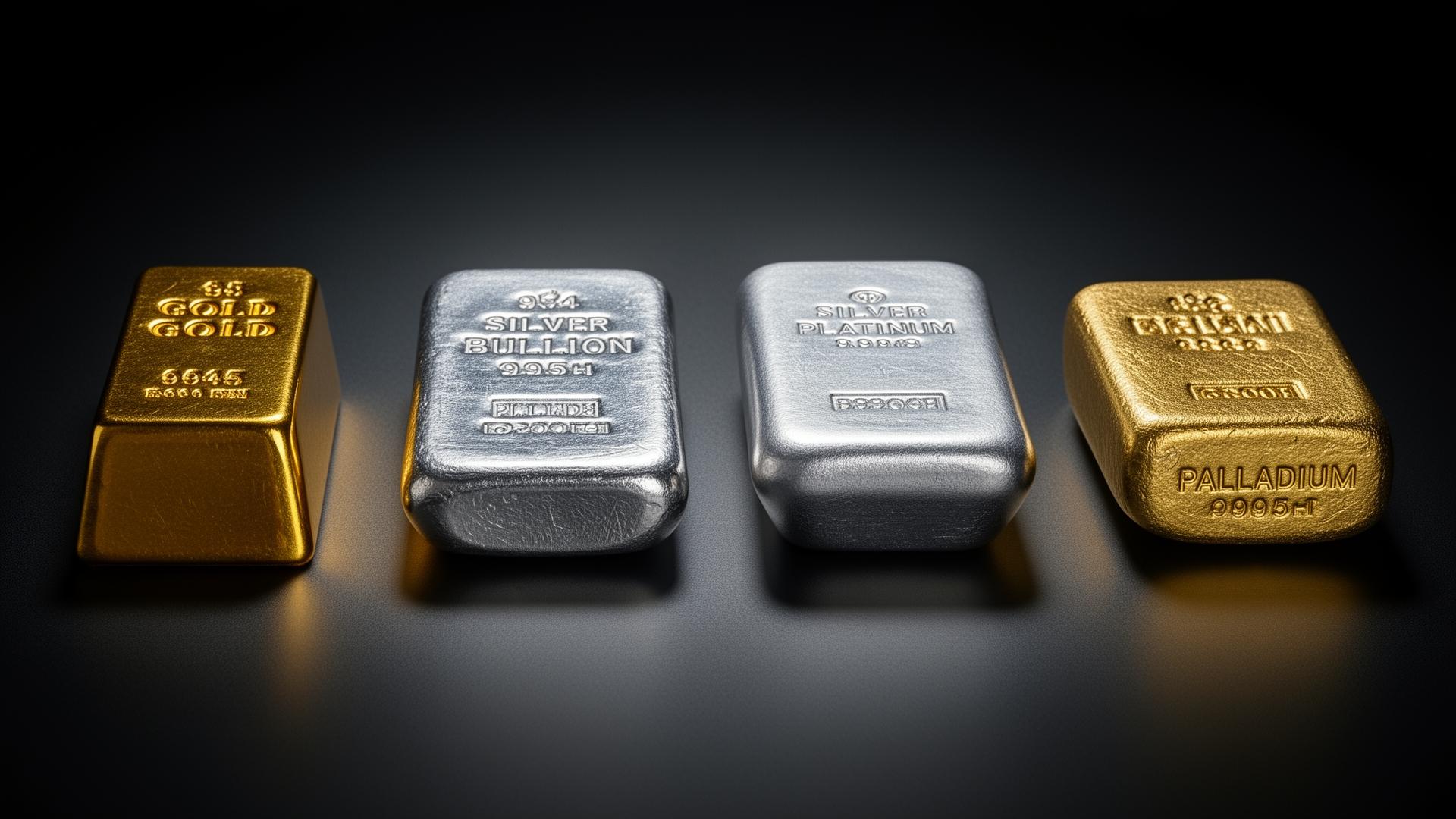
Not all precious metals behave the same way. Gold, silver, platinum, and palladium each have distinct price drivers, risk profiles, and roles in a portfolio. Choosing the wrong metal — or the wrong mix — can mean missing out on growth, taking on unnecessary volatility, or failing to get the protection you're looking for.
This guide breaks down each metal on its own terms: what drives its price, how it's performed historically, who it's best suited for, and how it fits into a broader investment strategy. Whether you're a first-time buyer or looking to rebalance, this comparison will help you make an informed decision.
The core question:
Are you investing for stability (gold), growth potential (silver), industrial upside (platinum), or speculative opportunity (palladium)? Your answer shapes everything.
Gold — Stability & Wealth Preservation
Gold is the anchor of the precious metals world. It's the most liquid, the most widely held by central banks, and the least dependent on industrial demand. Only about 8% of gold demand comes from industrial applications — the rest is investment, jewelry, and central bank reserves.
Pros
- Lowest volatility among precious metals — steadier price movements
- Universal liquidity — can be sold virtually anywhere in the world
- Proven inflation hedge — maintains purchasing power across decades
- Central bank demand — institutional buying provides a price floor
- IRA-eligible — approved for self-directed retirement accounts
Cons
- No income generation — no dividends, no interest
- Lower upside potential compared to silver or platinum in bull markets
- Higher price per ounce means higher entry cost for physical
- Taxed as a collectible at up to 28% for long-term capital gains
Best for:
Conservative investors, retirees, and anyone seeking long-term wealth preservation or a safe-haven hedge against economic uncertainty.
Silver — Growth Potential & Industrial Demand
Silver occupies a unique middle ground: it's both a monetary metal and an industrial workhorse. Roughly 50% of silver demand comes from industrial applications — solar panels, electronics, medical devices, and electric vehicles. This dual nature makes silver more volatile than gold but also gives it greater upside in economic expansions.
Pros
- Lower price per ounce — more accessible entry point
- Higher upside potential — silver typically outperforms gold in precious metals bull markets
- Growing industrial demand — solar energy, EVs, and 5G are structural tailwinds
- Historically undervalued — the gold-to-silver ratio has been elevated for years
- IRA-eligible — approved bullion can be held in retirement accounts
Cons
- Significantly more volatile than gold — larger drawdowns
- Bulkier to store — same dollar value requires much more physical space
- Industrial demand makes it sensitive to economic slowdowns
- Higher premiums over spot price, especially for small retail purchases
Best for:
Growth-oriented investors who can tolerate volatility and want exposure to both precious metals sentiment and industrial demand trends. Also a great entry point for beginners due to affordability.
Platinum — Scarcity & Industrial Upside
Platinum is approximately 30 times rarer than gold, yet it currently trades at a significant discount — a historical anomaly that has caught the attention of value-oriented investors. About 40% of platinum demand comes from automotive catalytic converters (primarily diesel engines), with growing demand from hydrogen fuel cell technology.
Pros
- Extreme rarity — 30x scarcer than gold
- Historically traded above gold — current discount may represent a value opportunity
- Hydrogen economy exposure — platinum is essential for fuel cell technology
- Supply concentration — 70% from South Africa creates supply squeeze potential
- IRA-eligible — approved platinum products can be held in retirement accounts
Cons
- Less liquid than gold or silver — fewer buyers and sellers
- Heavily dependent on automotive industry demand
- Geopolitical risk from concentrated supply chain (South Africa)
- Transition away from diesel engines has reduced one key demand driver
- Less established as a "safe haven" compared to gold
Best for:
Value investors and those with a long-term thesis on the hydrogen economy or structural supply deficits. Best as a secondary allocation after gold and silver.
Palladium — Niche & Volatile
Palladium is the rarest of the four major precious metals and the most industrially dependent. Over 80% of palladium demand comes from gasoline-engine catalytic converters. Russia and South Africa produce roughly 80% of the global supply, making palladium exceptionally sensitive to geopolitical disruptions and supply shocks.
Pros
- Extreme scarcity — the rarest of the four metals
- Supply constraints — concentrated production creates squeeze potential
- Massive price gains possible — palladium rose over 400% from 2016 to 2022
- Regulatory demand — tighter emissions standards drive catalytic converter usage
Cons
- Extremely volatile — sharp drawdowns are common
- Narrow demand base — almost entirely automotive
- EV transition is a long-term headwind (EVs don't use catalytic converters)
- Very low liquidity compared to gold and silver
- Limited investment products — fewer ETFs, coins, and bars available
- Not widely held by central banks — no institutional price floor
Best for:
Experienced investors comfortable with high volatility and willing to take a speculative position on supply/demand dynamics. Not recommended as a core holding.
Side-by-Side Comparison
Here's how the four major precious metals compare across the factors that matter most to investors:
| Factor | Gold | Silver | Platinum | Palladium |
|---|---|---|---|---|
| Primary demand | Investment & reserves | Industrial & investment | Automotive & hydrogen | Automotive (gasoline) |
| Industrial use | ~8% | ~50% | ~60% | ~80% |
| Volatility | Low | Medium-High | Medium-High | Very High |
| Liquidity | Excellent | Very Good | Moderate | Low |
| Safe haven | Strong | Moderate | Weak | Weak |
| Inflation hedge | Strong | Moderate | Mixed | Mixed |
| Entry cost | High | Low | Moderate | Moderate |
| IRA eligible | Yes | Yes | Yes | Yes |
| Central bank demand | Strong | None | None | None |
| Supply concentration | Diversified | Diversified | South Africa (~70%) | Russia & S. Africa (~80%) |
Historical Performance
Understanding how each metal has behaved during different market conditions helps set realistic expectations.
Gold
Gold has delivered consistent long-term returns, averaging roughly 8–10% annually over the past 20 years. It rose approximately 25% during the 2008 financial crisis while equities crashed. Gold reached all-time highs above $2,700/oz in late 2024, driven by central bank buying and geopolitical uncertainty.
Silver
Silver's performance is more cyclical. It spiked to nearly $50/oz in 2011 before falling to $14 by 2015. In bull markets, silver typically outperforms gold on a percentage basis — sometimes dramatically. The growing solar energy sector is creating structural demand that didn't exist a decade ago.
Platinum
Platinum historically traded above gold — sometimes by $500 or more per ounce. Since 2015, it has traded at a persistent discount, largely due to the "diesel-gate" scandal and the shift away from diesel vehicles in Europe. Some investors view this as a value anomaly that will eventually correct.
Palladium
Palladium experienced one of the most dramatic runs in precious metals history, rising from roughly $500/oz in 2016 to over $3,000/oz in 2022 due to chronic supply deficits. It has since corrected sharply. This metal demonstrates both the potential and the risk of concentrated industrial exposure.
Key historical pattern:
Gold leads in stability, silver leads in percentage gains during bull markets, platinum trades on scarcity narratives, and palladium is driven almost entirely by supply-demand mechanics. Past performance does not guarantee future results.
Which Metal Fits Your Profile?
Your investment goals, risk tolerance, and time horizon should determine which metals you prioritize.
🛡️ The Conservative Preserver
Focus: Wealth preservation, inflation protection, crisis insurance
Recommendation: 70–80% gold, 20–30% silver. Gold provides stability while silver adds moderate growth potential. Skip platinum and palladium.
📈 The Growth Seeker
Focus: Capital appreciation, higher returns, willing to accept volatility
Recommendation: 40–50% gold, 40–50% silver, 10% platinum. Silver's industrial demand and growth potential take center stage, with gold as a stabilizer.
🔬 The Diversified Strategist
Focus: Maximum diversification, exposure to multiple demand drivers
Recommendation: 50% gold, 30% silver, 15% platinum, 5% palladium. A multi-metal approach that captures different demand dynamics while keeping gold as the core.
🎯 The Beginner
Focus: Learning, starting small, building a foundation
Recommendation: Start with gold (or silver if budget is limited). Build a core position before exploring other metals. Read our Beginner's Guide first.
Building a Multi-Metal Portfolio
If you're going beyond a single metal, here are some principles to guide your allocation:
- Start with gold as your core: Most advisors recommend gold as 50–70% of a precious metals allocation. It's the foundation that provides stability, liquidity, and proven inflation protection.
- Add silver for growth: Silver offers higher upside potential and benefits from growing industrial demand (solar, EVs). Allocate 20–40% depending on your risk appetite.
- Consider platinum for value: If you believe the platinum discount to gold is a historical anomaly — or you're bullish on hydrogen fuel cells — a 5–15% allocation adds diversification.
- Use palladium sparingly: Keep palladium under 5–10% of your metals allocation. Its extreme volatility and narrow demand base make it a speculative satellite position, not a core holding.
- Rebalance based on ratios: The gold-to-silver ratio can help you identify when silver is relatively cheap compared to gold. Similar relative-value analysis applies to platinum and palladium.
Important note:
These are illustrative allocations, not personalized financial advice. Your optimal mix depends on your financial situation, investment goals, tax considerations, and risk tolerance. Consider consulting with a qualified financial advisor for personalized guidance.
Common Questions
Which precious metal is the best investment right now?
There's no single "best" metal — it depends on your goals. Gold is the safest for wealth preservation. Silver may offer better upside if you believe in the green energy transition. Platinum could be undervalued relative to gold. The right choice depends on your risk tolerance and investment thesis.
Should I invest in one metal or diversify across several?
Diversification within precious metals can reduce risk — but gold alone is a perfectly valid strategy, especially for beginners. If you diversify, keep gold as your core position and add smaller allocations to silver, platinum, or palladium based on your convictions.
What is the gold-to-silver ratio and why does it matter?
The gold-to-silver ratio measures how many ounces of silver it takes to buy one ounce of gold. Historically, this ratio has averaged around 60:1, but it often exceeds 80:1 during periods when silver is considered undervalued. Investors use it to time shifts between gold and silver allocations. Try our gold-to-silver ratio calculator.
Is platinum a good investment if it trades below gold?
Historically, platinum traded above gold for decades. The current discount is largely due to reduced diesel vehicle demand. Whether this represents a value opportunity depends on your view of platinum's industrial future — particularly hydrogen fuel cells. It's not a guaranteed "mean reversion" trade.
Can I hold all four metals in an IRA?
Yes. IRS-approved versions of gold, silver, platinum, and palladium can all be held in a self-directed precious metals IRA. Each metal must meet specific fineness requirements. See our Precious Metals in Retirement Accounts guide for full details.