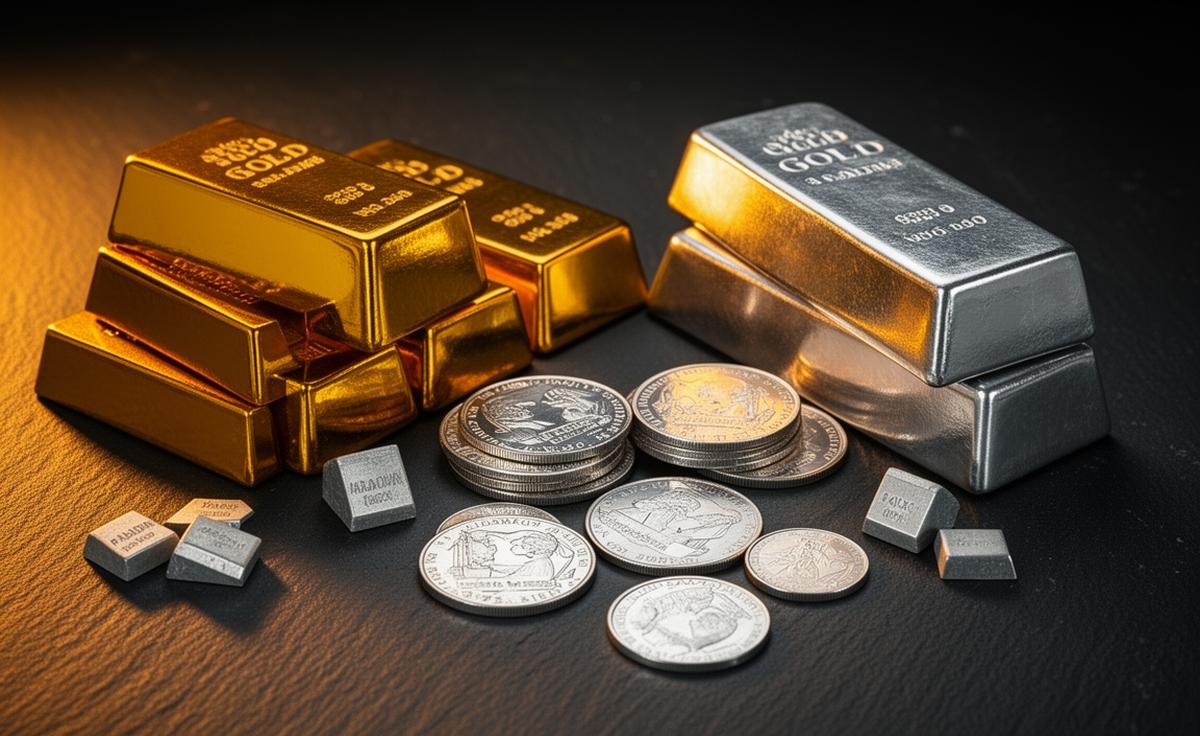
What Are Precious Metals?
Precious metals are naturally occurring metallic elements that are rare, durable, and have significant economic value. The four primary precious metals traded in financial markets are gold, silver, platinum, and palladium.
What separates precious metals from common metals like copper or aluminum is a combination of scarcity, resistance to corrosion, and centuries of perceived value. They can't be printed by a government, they don't expire, and their supply is limited by what can physically be mined from the Earth.
Think of it this way:
A dollar bill is a promise. A gold coin is the thing itself. That distinction has made precious metals a store of value across every civilization in recorded history — from ancient Egypt to modern central banks.
Today, precious metals serve three overlapping roles: monetary assets (reserves held by central banks), industrial materials (used in electronics, catalytic converters, and medicine), and investment vehicles (coins, bars, ETFs, and mining stocks).
Why People Invest in Precious Metals
People don't buy gold because it pays a dividend or posts quarterly earnings. They buy it for fundamentally different reasons than stocks or bonds — and understanding those reasons is the key to knowing whether metals belong in your portfolio.
1. Hedging Against Inflation
When the cost of living rises — groceries, gas, housing — the purchasing power of cash declines. Precious metals tend to hold or increase in value during inflationary periods because their supply can't be inflated the way currency can. Gold in particular has historically kept pace with or exceeded inflation over long time horizons.
2. Portfolio Diversification
Precious metals often move independently of — or inversely to — stocks and bonds. This low correlation makes them a diversification tool: when traditional markets fall, metals may hold steady or rise, cushioning overall portfolio losses.
3. Long-Term Wealth Preservation
An ounce of gold bought the same amount of bread 100 years ago as it does today. That's the power of real, tangible value. Investors focused on multi-generational wealth — or simply protecting retirement savings — turn to metals as a store of purchasing power.
4. Safe Haven During Crises
During geopolitical tensions, banking failures, currency collapses, and pandemics, investors historically flock to gold and silver. These metals are perceived as "crisis insurance" — assets that hold value when confidence in institutions erodes.
5. Currency Devaluation Protection
When governments run large deficits, increase money supply, or devalue their currencies, precious metals priced in those currencies tend to rise. This makes metals a natural counterweight to loose monetary policy.
Gold — The Anchor Asset
Gold is the most widely recognized and traded precious metal in the world. Central banks hold approximately 36,000 tonnes of gold in reserves — a testament to its enduring role in the global financial system.
For individual investors, gold serves primarily as a wealth preservation asset. It doesn't generate income like a rental property or stock dividend, but it also can't go bankrupt, be diluted, or default. Its value is rooted in scarcity, durability, and universal acceptance.
Key characteristics of gold:
- Extremely liquid — can be sold almost anywhere in the world
- Minimal industrial demand (~8%) — price is driven by investment sentiment
- Strong track record during inflationary and deflationary periods
- Eligible for inclusion in self-directed IRAs
Gold is often the starting point for beginner precious metals investors because it's the most liquid, the most studied, and the least volatile of the group.
Silver — The Dual-Role Metal
Silver is unique among precious metals because it straddles two worlds: it's both a monetary metal (like gold) and an industrial metal (like copper). Roughly 50% of silver demand comes from industrial applications — solar panels, electronics, medical devices, and water purification.
This dual nature makes silver more volatile than gold. When industrial demand surges (as with the global green energy transition), silver can outperform gold significantly. But in economic downturns, reduced industrial demand can weigh on its price more than on gold.
Key characteristics of silver:
- Lower price per ounce — more accessible entry point for new investors
- Higher volatility — larger percentage swings than gold
- Growing industrial demand from solar energy and electronics
- Historically undervalued relative to gold (gold-to-silver ratio)
Many investors use the gold-to-silver ratio to gauge whether silver is relatively cheap or expensive compared to gold, and time their allocations accordingly.
Platinum & Palladium
Platinum and palladium are the less familiar members of the precious metals family, but they play critical roles in the global economy — particularly in the automotive and green energy sectors.
Platinum
Approximately 30 times rarer than gold, platinum is used in catalytic converters, jewelry, and increasingly in hydrogen fuel cells. It currently trades below gold — a historical anomaly that some investors view as a potential opportunity. South Africa produces roughly 70% of the world's platinum supply, making it geopolitically sensitive.
Palladium
Palladium is the rarest of the four major precious metals and is primarily used in gasoline-engine catalytic converters. Russia and South Africa dominate global supply. Palladium's price can be extremely volatile due to its concentrated supply chain and narrow demand base.
For beginners, platinum and palladium are best viewed as secondary allocations — complementary positions that add diversification after you've established a foundation in gold and silver. You can explore each in depth in our dedicated Platinum and Palladium investment guides.
Precious Metals vs Stocks & Bonds
Understanding how precious metals compare to traditional financial assets is essential for building a balanced portfolio. Here's how they stack up:
| Factor | Precious Metals | Stocks | Bonds |
|---|---|---|---|
| Income | None (no dividends/interest) | Dividends possible | Regular interest payments |
| Inflation hedge | Strong (especially gold) | Mixed — depends on sector | Weak — fixed income loses value |
| Crisis performance | Tends to rise | Tends to fall | Varies by type |
| Counterparty risk | None (physical) | Company can go bankrupt | Issuer can default |
| Growth potential | Moderate (price appreciation) | High (earnings growth) | Low (fixed returns) |
| Tax treatment | Collectibles rate (up to 28%) | Capital gains (up to 20%) | Ordinary income |
The takeaway: precious metals aren't designed to replace stocks or bonds — they're designed to complement them. Most financial strategists who recommend metals suggest an allocation of 5–15% of a portfolio, depending on risk tolerance and market outlook.
Risk vs Reward Basics
No investment is without risk, and precious metals are no exception. Here's a clear-eyed view of what you're gaining — and what you're giving up.
Potential Rewards
- Capital preservation: Physical metals can't go to zero. Unlike stocks, they have intrinsic value rooted in scarcity and physical properties.
- Portfolio stability: Low or negative correlation with equities can reduce overall portfolio volatility.
- Crisis outperformance: Gold rose approximately 25% during the 2008 financial crisis while the S&P 500 fell over 50%.
- Global liquidity: Gold and silver are recognized and tradeable virtually anywhere in the world.
Key Risks
- No income generation: Metals don't pay dividends or interest. Returns come only from price appreciation.
- Short-term volatility: Silver in particular can experience sharp price swings. Gold dropped ~28% from 2011 to 2015 before recovering.
- Storage and insurance costs: Physical metals require secure storage, which adds ongoing expense.
- Higher tax rates: The IRS classifies physical metals as collectibles, subject to a maximum 28% long-term capital gains rate — higher than the 20% rate for most other assets.
- Opportunity cost: Capital invested in metals isn't earning dividends or compounding through reinvestment.
Ways to Get Started
There are several paths into precious metals investing, each with different trade-offs:
Physical Coins & Bars
Buying recognized bullion products — American Gold Eagles, Canadian Maple Leafs, silver rounds — from a reputable dealer. You own the metal directly with no counterparty risk, but you need secure storage and insurance. This is the most traditional approach.
Precious Metals IRAs
Self-directed IRAs allow you to hold IRS-approved physical gold, silver, platinum, and palladium in a tax-advantaged retirement account. You get the tax benefits of an IRA with the inflation protection of physical metals. See our Gold IRA Investment Guide for details.
ETFs (Exchange-Traded Funds)
Metal-backed ETFs let you buy exposure through a regular brokerage account. They're liquid and convenient but introduce counterparty risk — you own shares in a fund, not the physical metal itself.
Mining Stocks & Funds
Shares in gold, silver, or platinum mining companies offer leveraged exposure to metal prices. They can outperform physical metals in bull markets but carry company-specific risks (management, debt, geopolitics). See our Gold Stock and Silver Stock guides for more.
Common Beginner Mistakes
- Over-allocating: Putting too large a percentage of your portfolio into metals. Most experts suggest 5–15%, not 50%.
- Buying numismatic coins instead of bullion: Collectible coins carry large premiums over spot price. Beginners should stick to standard bullion products.
- Ignoring storage costs: Premiums, shipping, insurance, and vault fees can erode returns if not planned for.
- Chasing short-term price spikes: Metals are best used for long-term preservation, not day-trading. Buying at all-time highs out of fear is a common trap.
- Using unvetted dealers: The precious metals industry has its share of high-pressure operations. Research dealer reputations before buying. Our company rankings can help.
- Not understanding tax implications: The 28% collectibles tax rate surprises many first-time sellers. Know the rules before you buy. See our guide on tax implications.
Common Questions
How much money do I need to start investing in precious metals?
You can start with as little as $50–$100 by purchasing fractional gold coins or silver rounds. Silver is especially accessible — a single one-ounce silver coin typically costs under $40. There's no minimum account size for most bullion dealers.
Should I buy gold or silver first?
Most advisors recommend starting with gold due to its stability and liquidity. Once you have a core gold position, silver can be added for growth potential and diversification. Your risk tolerance and investment timeline should guide the split.
Is now a good time to buy precious metals?
Timing the market is notoriously difficult. Many long-term investors use dollar-cost averaging — buying fixed amounts at regular intervals — to smooth out price fluctuations. The "right time" depends on your investment goals, not short-term price predictions.
Are precious metals a safe investment?
Physical precious metals carry no counterparty risk — they can't go bankrupt or be devalued by a corporate decision. However, their prices do fluctuate, sometimes significantly. They're best viewed as a long-term wealth preservation tool, not a guaranteed return.
Where should I store physical gold and silver?
Options include home safes, bank safe deposit boxes, and third-party vaults (depositories). For IRA-held metals, IRS rules require storage at an approved depository. For personal holdings, the choice depends on the value held and your security preferences.