1853-O No Arrows Half Dollar: A US Coin Rarity
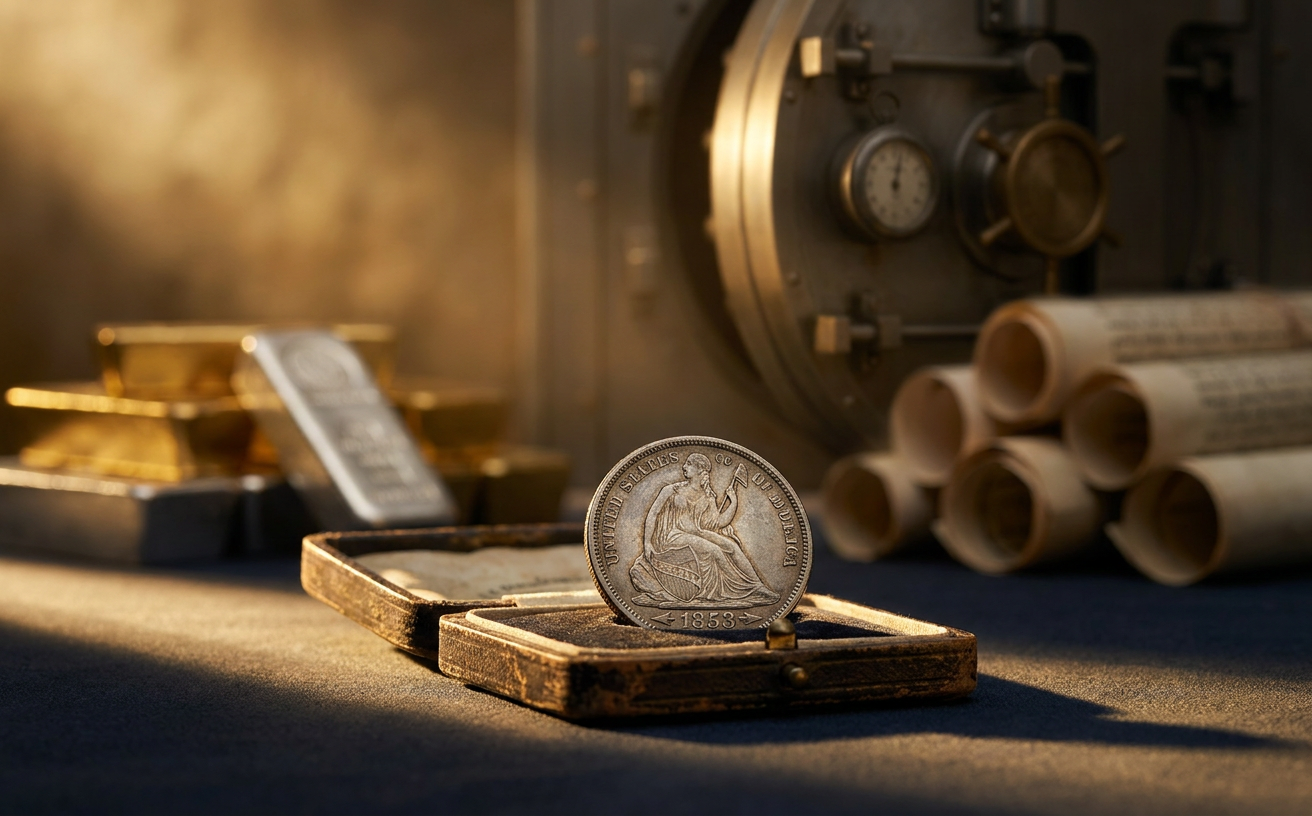
Certain rare coins serve as more than just collectibles; they are tangible relics of pivotal moments in a nation’s history. The 1853-O Seated Liberty Half Dollar with no arrows at the date is one such artifact. An issue of profound rarity, with only four known examples, it tells a fascinating story of monetary crisis, technological change, and near-accidental preservation. This coin, born from the New Orleans Mint, was almost immediately consumed by the economic forces that made it obsolete upon arrival.
Key Takeaways
The 1853-O No Arrows Seated Liberty Half Dollar is an extreme numismatic rarity, with a surviving population of only four known coins.
Its scarcity is a direct result of the Mint Act of 1853, which Congress passed to address a crisis where silver coins were worth more as bullion than as money.
The Act reduced the silver weight of new half dollars and added arrows to the design to identify them; the 1853-O No Arrows coins, lacking these marks, were rapidly melted down for their higher silver content.
All four known examples originate from the same pair of dies and show signs of circulation, with one specimen famously discovered in a suitcase of old coins, having nearly been sold for its melt value.
America's Mid-Century Silver Crisis
To understand the rarity of the 1853-O No Arrows half dollar, one must first understand the monetary environment of the early 1850s. The California Gold Rush had injected an enormous amount of gold into the U.S. economy. According to basic economic principles, this sudden oversupply of gold effectively lowered its price relative to silver. Consequently, the intrinsic value of the silver in U.S. coinage began to exceed the coins' designated face value. For instance, the silver within two half dollars became worth more than one dollar.
This imbalance created a powerful incentive for individuals and speculators to pull silver coins from circulation. Seated Liberty half dollars, along with dimes, quarters, and half dimes, were hoarded, melted down for their bullion, or exported to be sold as raw metal. By early 1853, fractional silver currency had all but vanished from daily commerce, creating a significant problem for merchants and the public alike.
The Mint Act of 1853 and A Design Change
Congress moved to resolve the crisis with the Mint Act of February 21, 1853. The legislation authorized a reduction in the silver content of subsidiary coins—all silver denominations except the dollar. For the half dollar, the weight was reduced by approximately 6.9%, from 13.36 grams (206.25 grains) to 12.44 grams (192 grains). This adjustment made melting the coins unprofitable.
To signal this change to the public, the U.S. Mint altered the coins' designs. For quarters and half dollars, small arrows were placed on either side of the date, and a glory of rays was added to the reverse around the eagle. These visual cues informed people that the coins were of the new, lighter standard. The rays were removed after just one year, but the arrows remained through 1855.
Doomed from the Day of Striking
The 1853-O No Arrows half dollar was a victim of unfortunate timing. The New Orleans Mint, having received its dies from Philadelphia in late 1852, began striking half dollars in January 1853, before the new law was passed. These coins were produced according to the old, heavier weight standard and, crucially, without the arrows and rays. While there are no official mintage records for this specific variety, numismatic experts estimate that no more than a few thousand could have been produced.
When the new, lighter "Arrows and Rays" half dollars entered circulation, the 1853-O No Arrows coins were indistinguishable from the pre-1853 issues that people were already actively melting. As a result, nearly the entire mintage was destroyed, vanishing into melting pots almost as quickly as it was created.
The Four Surviving Coins
The coin collecting community, or numismatics, did not become widely aware of the 1853-O No Arrows variety until the 1880s. Today, only four specimens are generally accepted as authentic. Intriguingly, all four were struck from the same die pair, identified by die characteristics that link the reverse to a die used for 1852-O half dollars.
The finest known example, graded Very Fine (VF-35), has a prestigious ownership history including the Garrett family and sold for $517,000 in a 2017 auction. Another, graded Very Good (VG-08), was part of a remarkable discovery in 2012 when it was found among silver coins stored in a suitcase. A third example has an even longer provenance, passing through the hands of famous collectors like Eliasberg and Newcomer. The fourth known coin is graded Good (G-06).
The Suitcase Coin: A Near-Total Loss
The story of the 2012 discovery highlights the razor-thin margin by which these coins survived. A family in Washington state possessed a suitcase filled with silver coins collected by their father. Unaware of its significance, they took the 1853-O half dollar to a local coin shop, which initially offered them just $15, its approximate silver melt value.
However, the owner's husband recalled seeing high values for this date in a reference book and noted the absence of the key arrows and rays. His persistence prompted a second look, saving a coin worth hundreds of thousands of dollars from being lost forever and adding a compelling human element to the story of this great American rarity.
Frequently Asked Questions
Why is the 1853-O No Arrows half dollar so rare?
It was produced at an old, heavier silver standard just before the U.S. Mint reduced the weight of silver coins. Because it lacked the "arrows" used to mark the new, lighter coins, it was mistaken for other overweight coins and almost entirely melted down for its higher silver content.
How many 1853-O No Arrows half dollars exist?
Only four examples are known and widely accepted by numismatic experts today. All known survivors were struck from the same pair of dies.
What do the arrows on Seated Liberty half dollars signify?
Arrows were added to the date of Seated Liberty coinage in 1853 to provide a clear visual signal to the public that the coins were struck to a new, lighter weight standard as mandated by the Mint Act of 1853. This was done to stop the widespread melting of U.S. silver coins.
This article is for educational purposes only and should not be considered investment advice. The value of rare coins can be subjective and is influenced by factors such as rarity, grade, and historical significance. All investments, including collectibles, carry risks.
Found this article helpful?
Take Our 1-Minute Gold IRA Match Quiz
Get a personalized recommendation based on your goals and investment style.
Explore Related Topics
For Investors Who Don't Have Time to Chase Headlines
Industry news distilled into a scannable email.
Vincent Edwards
Our editorial team covers numismatics for Precious Metals Report, focused on clear, unbiased reporting and investor education.
Read more from this author