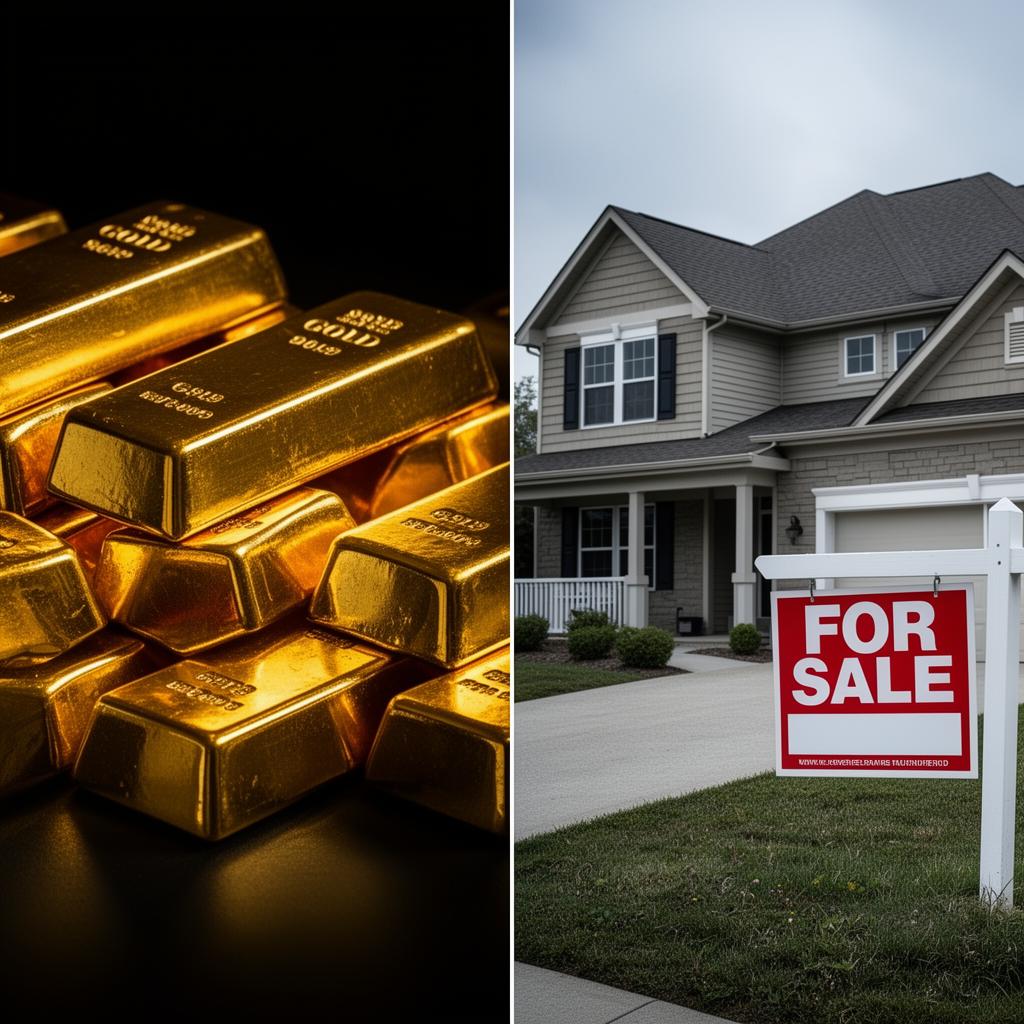
Gold vs Real Estate: Which Store of Value Makes Sense in a High-Risk Market?
Key Takeaways
- 1Real estate carrying costs — insurance, taxes, maintenance — have surged in 2025, eroding risk-adjusted returns for property investors.
- 2Gold is one of the most liquid assets on Earth, with 1–4% transaction costs versus 6–10% for real estate sales.
- 3Gold's near-zero correlation with equities and real estate makes it a powerful portfolio diversifier during credit crises.
- 4Physical gold costs $150–$400/year to hold versus $8,000–$15,000+ for an equivalent value in real estate.
- 5The optimal approach for most investors is holding both assets, but adjusting allocation to reflect current risk conditions.
For decades, real estate and gold have both been marketed as "safe" stores of value. But in 2025, the risk profiles of these two asset classes are diverging sharply. Rising interest rates, insurance crises, property tax reassessments, and a slowing transaction market are exposing structural vulnerabilities in real estate that gold simply doesn't share.
This isn't an argument that one asset is categorically better than the other. Both have a role. But if you're comparing them as stores of value in a high-risk environment — the kind defined by elevated inflation, geopolitical instability, and monetary policy uncertainty — the differences matter more than most investors realize.
Why Real Estate Is Struggling in 2025
The U.S. housing market entered 2025 under significant stress. Mortgage rates remain elevated, hovering near 7% for a 30-year fixed, pricing out a large segment of would-be buyers. Existing home sales have fallen to their lowest levels since the mid-1990s, and while prices haven't collapsed nationally, they've stagnated or declined in many formerly hot markets.
But price is only part of the story. The cost of holding real estate has increased dramatically:
- Property insurance premiums have surged — up 30–60% in states like Florida, Texas, California, and Louisiana, with some carriers exiting entire markets
- Property taxes have risen alongside reassessments tied to pandemic-era price spikes, even in markets where values have since corrected
- Maintenance and repair costs have inflated alongside labor and materials, with the average homeowner spending $6,000–$18,000 annually on upkeep depending on age and condition of the property
- HOA fees have increased significantly, particularly in condo markets facing deferred maintenance liabilities post-Surfside collapse regulations
For investors holding rental properties, the math has tightened further. Vacancy rates are climbing in overbuilt Sun Belt markets, and rent growth — which was running at 10–15% annually during 2021–2022 — has decelerated to low single digits or turned negative in some metros.
None of this means real estate is worthless. It means the risk-adjusted return of holding property has deteriorated, and investors need to honestly compare it to alternatives.
Liquidity and Leverage Risks
This is where the gold vs. real estate comparison gets most uncomfortable for property investors.
Real estate is inherently illiquid. Selling a home in a normal market takes 30–90 days. In a stressed market, it can take six months to a year — or longer if you're not willing to accept significant price concessions. Transaction costs (agent commissions, closing costs, transfer taxes, staging, repairs) typically consume 6–10% of the sale price.
Gold, by contrast, is one of the most liquid assets on Earth. Physical gold can be sold to any reputable dealer within hours, and the spread between buy and sell prices for standard bullion products (American Gold Eagles, Canadian Maple Leafs, LBMA-approved bars) is typically 1–4%. There are no staging costs, no inspections, no buyer financing contingencies.
Leverage amplifies both the opportunity and the risk in real estate. Most residential real estate is purchased with 80–95% leverage. When prices rise, returns on equity are magnified. When prices fall, the same leverage can wipe out your entire equity position — and you still owe the mortgage. The 2008 financial crisis demonstrated this at scale, and the current environment shares some of the same warning signals: elevated household debt, stretched affordability ratios, and tightening credit standards.
Gold carries no leverage unless you choose to introduce it through futures or margin accounts. Physical gold in your possession or in an IRA depository has zero counterparty risk — it doesn't depend on a bank, a tenant, or a mortgage servicer to retain its value. For more on how gold performs during systemic stress, see our Wealth Preservation Guide.
Metals as a Non-Correlated Asset
One of gold's most underappreciated advantages is its low correlation with both equities and real estate. Over the past 50 years, gold's correlation with the S&P 500 has averaged roughly 0.0 to 0.1 — meaning it moves largely independently of stock markets. Its correlation with residential real estate is similarly low.
This matters for portfolio construction. When stocks decline and real estate values soften — as tends to happen during recessions and credit crises — gold has historically held value or appreciated. During the 2008–2009 financial crisis, the S&P 500 fell roughly 57%, U.S. home prices dropped 33% peak-to-trough, and gold rose approximately 25%.
Real estate, on the other hand, is highly correlated with credit conditions. When lending tightens, transaction volume drops, prices stagnate, and liquidity evaporates — exactly the conditions you see today. Real estate is also correlated with employment trends, population migration patterns, and local government policy, all of which introduce idiosyncratic risks that gold doesn't carry.
Central banks don't hold residential real estate in their reserves. They hold gold. As of 2025, central bank gold purchases have exceeded 1,000 tonnes annually for three consecutive years — a structural demand signal that has no equivalent in the real estate market. For more on how central bank activity drives gold, see our Central Bank Gold Buying analysis.
Maintenance vs Zero Maintenance
This comparison is stark and often underestimated by real estate investors who focus on appreciation potential without fully accounting for carrying costs.
Real estate requires active, ongoing maintenance. Roofs need replacement every 15–25 years ($8,000–$30,000). HVAC systems last 10–15 years ($5,000–$15,000 to replace). Plumbing, electrical, landscaping, pest control, appliance replacement — the costs are continuous and often unpredictable. A single major repair can consume years of rental income or meaningfully reduce net sale proceeds.
If you hold rental property, add property management (typically 8–12% of gross rent), tenant turnover costs, legal compliance, and the time cost of being a landlord. Even "passive" real estate income requires significant active management.
Physical gold requires essentially zero maintenance. An ounce of gold minted in 1980 is worth exactly the same as an ounce minted in 2025 — the metal doesn't degrade, doesn't require insurance beyond basic storage coverage, and doesn't need repairs. If held in an IRA, your custodian handles storage at a depository for roughly $100–$300 per year. If held privately, a quality safe and a rider on your homeowner's insurance covers it.
The total annual carrying cost of $100,000 in physical gold is roughly $150–$400 (storage + insurance). The total annual carrying cost of $100,000 in real estate — between taxes, insurance, maintenance, and potential vacancy — can easily run $8,000–$15,000 or more.
When Each Asset Makes Sense
The honest answer is that gold and real estate serve different functions, and the right choice depends on your financial situation, time horizon, and risk tolerance.
Real estate makes sense when:
- You're buying a primary residence in a market with strong fundamentals (job growth, population growth, constrained supply)
- You have the financial capacity to hold through downturns without being forced to sell
- You can genuinely generate positive cash flow after all expenses — not just on a spreadsheet, but in practice
- You're in a tax bracket where mortgage interest deductions and depreciation provide meaningful benefits
- You have the time, expertise, or resources to manage properties actively
Gold makes sense when:
- You want a liquid, portable store of value that exists outside the financial system
- You're hedging against inflation, currency debasement, or systemic financial risk
- You want to diversify a portfolio that's already heavy in equities and/or real estate
- You want zero-maintenance wealth preservation with minimal carrying costs
- You're within 5–15 years of retirement and want to reduce portfolio volatility
For many investors, the optimal approach is holding both — but the allocation should reflect current risk conditions. In an environment where real estate carrying costs are rising, liquidity is shrinking, and monetary uncertainty is elevated, increasing your gold allocation from 0–5% to 10–15% is a reasonable response that many financial advisors are now recommending.
For more on building a balanced precious metals position, see our guide to building a metals position and our Gold IRA Investment Guide.
Conclusion
Gold and real estate have both preserved wealth over long periods. But they are not interchangeable, and the current environment highlights their differences more than usual. Real estate is leveraged, illiquid, maintenance-intensive, and highly sensitive to credit conditions and local market dynamics. Gold is unleveraged, highly liquid, zero-maintenance, and responds to entirely different macroeconomic forces.
Neither asset is inherently "better." But in a high-risk market defined by monetary uncertainty, rising carrying costs, and deteriorating real estate liquidity, gold's structural advantages as a store of value become significantly more relevant. The investors who perform best over the next decade are likely to be those who understand both assets clearly — and size their positions accordingly.
This article is for educational purposes only and does not constitute investment, tax, or legal advice. Past performance is not indicative of future results. Consult a qualified financial advisor before making investment decisions.
Found this article helpful?
Take Our 1-Minute Gold IRA Match Quiz
Get a personalized recommendation based on your goals and investment style.
Frequently Asked Questions
Explore Related Topics
For Investors Who Don't Have Time to Chase Headlines
Industry news distilled into a scannable email.
Vincent Edwards
Vincent Edwards is the editor and lead analyst at Precious Metals Report, specializing in gold and silver market analysis, retirement investing, and macroeconomic trends.
Read more from this author