Why Geopolitical Tension Always Pushes Gold Higher
Key Takeaways
- 1Gold has risen during every major armed conflict, trade war, and geopolitical crisis in modern history — the pattern is structural, not coincidental.
- 2The freezing of $300 billion in Russian reserves in 2022 fundamentally changed how nations view dollar-denominated assets, accelerating central bank gold purchases to record levels.
- 3Trade wars and currency weaponization create sustained gold demand by introducing political risk into assets previously considered safe.
- 4Silver amplifies gold's safe-haven dynamic with 2-3x greater price movement, plus additional industrial supply disruption premiums during geopolitical stress.
- 5The current geopolitical landscape — with simultaneous conflicts, trade wars, and de-dollarization — represents a structural shift that supports sustained precious metals demand.
Gold doesn't need a marketing campaign. Every time a missile launches, a trade war escalates, or a government freezes another nation's reserves, gold makes the case for itself. The relationship between geopolitical risk and gold prices isn't a coincidence or a short-term trading phenomenon — it's a structural feature of how the global financial system responds to uncertainty.
For thousands of years, gold has served as the asset of last resort when institutions fail, currencies falter, and the rules of international commerce get rewritten overnight. Understanding why this pattern holds — and how it manifests across different types of geopolitical stress — is essential for anyone positioning their portfolio for a world that shows no signs of becoming more stable.
Gold During Major Conflicts
The historical record is unambiguous: gold rises during periods of armed conflict. The mechanism is straightforward — wars create uncertainty about economic outcomes, disrupt supply chains, strain government budgets, and often lead to currency devaluation as nations print money to finance military operations.
World War II and the Post-War Order
During World War II, gold served as the ultimate neutral settlement asset. Nations used gold to purchase weapons, food, and strategic materials when paper currencies lost credibility across battle lines. The war's aftermath produced the Bretton Woods system, which explicitly anchored the global monetary order to gold at $35 per ounce — a tacit acknowledgment that after the destruction of entire economies, only gold retained universal trust.
The Vietnam War Era (1965-1975)
The Vietnam War's ballooning costs forced the U.S. to print money at an unsustainable rate, ultimately leading President Nixon to sever the dollar's gold convertibility in 1971. This "Nixon Shock" unleashed gold from its $35 peg. By 1980, gold had surged to $850 per ounce — a 2,300% increase — driven by the combination of war spending, inflation, and the resulting loss of confidence in the dollar.
The Gulf Wars (1990-2003)
Iraq's invasion of Kuwait in 1990 sent gold spiking 10% in a matter of days. The 2003 invasion of Iraq produced a similar response. In both cases, gold's movement was driven less by the military outcome (which was never seriously in doubt) and more by the uncertainty about oil supply disruption, regional destabilization, and the broader implications for Middle Eastern stability.
The Russia-Ukraine Conflict (2022-Present)
Russia's invasion of Ukraine in February 2022 sent gold surging above $2,050 — at the time, near all-time highs. But the more lasting impact came from the Western response: the freezing of approximately $300 billion in Russian central bank reserves. This single act fundamentally changed how every non-Western nation viewed dollar-denominated assets.
If reserves held in dollars, euros, and pounds could be frozen by political decision, then those reserves weren't truly "safe." The result has been a historic acceleration in central bank gold purchases, as nations sought to hold reserves in an asset that cannot be frozen, seized, or sanctioned. For more on this trend, see our Central Bank Gold Reserves Analysis.
Middle East Escalation (2024-2025)
The dramatic escalation of Middle East tensions in late 2024, spreading beyond any single conflict into a broader regional crisis, pushed gold above $2,800 and contributed to the momentum that carried prices past $3,800 in 2025. Each new front, each new actor drawn into the conflict, reinforced gold's role as the asset you hold when you genuinely don't know what happens next.
Why Investors Flee to Safety
The phrase "flight to safety" gets used so often in financial media that it's become a cliché. But understanding the specific mechanisms behind this behavior explains why gold — and not other "safe" assets — is the ultimate beneficiary of geopolitical stress.
Uncertainty vs. Risk
Financial models can price risk — quantifiable probabilities of known outcomes. What they cannot price is uncertainty — situations where the range of possible outcomes is unknown, or where entirely unprecedented events may occur. Geopolitical crises produce uncertainty, not risk. When Russia invades Ukraine, the question isn't "what's the probability of X?" — it's "what outcomes are even possible?"
In these environments, investors don't seek the highest return. They seek the asset with the fewest assumptions embedded in its value. Stocks require corporate earnings. Bonds require government solvency. Real estate requires functioning local economies. Gold requires nothing — its value is inherent, recognized globally, and independent of any institution's performance.
The Psychology of Tangibility
When geopolitical events shake confidence in the systems that underpin paper wealth, there's a powerful psychological draw toward assets you can see, touch, and physically possess. This isn't irrational — it's the recognition that in genuinely extreme scenarios, digital account balances and paper claims may not function as expected.
Gold's 5,000-year track record as a store of value isn't just a statistic. It's a psychological anchor. Every civilization that has ever existed has recognized gold's value. That universality is itself a form of security that no paper asset can replicate.
Institutional Behavior Amplifies the Move
When geopolitical tensions rise, it's not just retail investors buying gold. Central banks, sovereign wealth funds, pension funds, and insurance companies all shift allocations toward safe-haven assets. These institutional flows are massive — measured in billions of dollars — and they create sustained price support that outlasts the initial headline shock.
The World Gold Council reports that central banks purchased over 1,100 tonnes of gold in 2024, continuing a trend that accelerated sharply after Russia's reserves were frozen. This institutional buying creates a structural floor under gold prices that didn't exist a decade ago.
Trade Wars and Currency Wars
Armed conflict is the most visible form of geopolitical tension, but trade wars and currency wars can be equally — sometimes more — impactful for gold prices. The reason is simple: trade and currency conflicts directly threaten the economic infrastructure that paper assets depend on.
Trump-Era Tariffs and Gold
The U.S.-China trade war that began in 2018 sent gold from approximately $1,200 to $1,550 by mid-2019 — a 29% move driven entirely by trade policy uncertainty. When tariffs were expanded and escalated in 2025, gold's response was even more dramatic, contributing to the metal's surge past $3,800.
Tariffs don't just raise prices — they disrupt the assumptions underlying global supply chains. Companies can't plan capital expenditure when trade rules change unpredictably. Investors can't value multinational corporations when their cost structures might shift overnight. This uncertainty premium flows directly into gold.
Currency Weaponization
The use of the dollar as a weapon — through sanctions, reserve freezes, and SWIFT exclusions — has accelerated a fundamental rethinking of the global monetary order. When the U.S. froze Russian reserves and excluded Russian banks from SWIFT, it demonstrated that dollar-denominated assets carry political risk — a category of risk that was previously considered negligible for sovereign reserves.
The response has been a coordinated effort among BRICS nations to build alternative payment systems, settle bilateral trade in local currencies, and accumulate gold as a neutral reserve asset. This de-dollarization trend is perhaps the most structurally important driver of gold demand in the current era — because it represents not a temporary trade, but a permanent shift in how nations think about reserve management. For more on how macro forces drive metals, see our Market Drivers Guide.
Sanctions as a Gold Catalyst
Every new round of sanctions reinforces gold's value proposition. When Iran was sanctioned, gold smuggling became a primary mechanism for circumventing financial restrictions. When Venezuela's assets were frozen, gold reserves became the country's most valuable remaining asset. When Russian oligarchs faced asset freezes, gold and other tangible assets became the preferred store of wealth.
The pattern is consistent: sanctions increase gold demand both from sanctioned parties seeking non-freezable assets and from observers who recognize they could face similar treatment in the future.
Silver's Role in Global Instability
While gold gets the "safe haven" headlines, silver plays a distinct and complementary role during geopolitical instability — one that's often more explosive in terms of price movement.
Silver as Leveraged Gold
Silver historically moves 2-3x faster than gold in both directions. During the geopolitically charged environment of 2025, this pattern held: gold surged approximately 45%, while silver rocketed over 108%. For investors who correctly identify a geopolitical catalyst for precious metals, silver offers significantly greater upside — with correspondingly greater volatility.
Industrial Vulnerability Creates Additional Demand
Unlike gold, silver has massive industrial applications — solar panels, electronics, medical devices, and defense systems all require silver. Geopolitical instability that disrupts supply chains (particularly from major silver-producing regions like Mexico, Peru, and China) can create supply squeezes that amplify silver's safe-haven rally with an industrial shortage premium.
China's recent moves to restrict silver exports, framed as protecting strategic mineral supplies, added a geopolitical supply dimension to silver's already tight market. For more on this dynamic, see our analysis of China's Silver Export Controls.
Historical Silver Spikes During Crises
Silver's most dramatic moves have consistently coincided with periods of geopolitical and monetary upheaval:
- 1979-1980: Soviet invasion of Afghanistan, Iranian Revolution, and Hunt Brothers' accumulation pushed silver from $6 to nearly $50
- 2010-2011: Arab Spring, European debt crisis, and post-financial-crisis monetary expansion drove silver from $17 to $49
- 2025: Trade wars, Middle East escalation, and de-dollarization combined with industrial supply deficits to push silver past $60
The common thread: each spike occurred during periods of overlapping geopolitical and monetary stress, where silver's dual role as safe haven and industrial metal created compounding demand pressures.
Accessibility for Smaller Investors
Silver's lower price point makes it accessible in ways that gold isn't. During periods of geopolitical anxiety, retail investors who can't afford gold at $3,800+ per ounce often turn to silver as their entry point into precious metals. This retail demand adds another layer of buying pressure during crisis periods, particularly for physical coins and small bars.
The Current Geopolitical Landscape
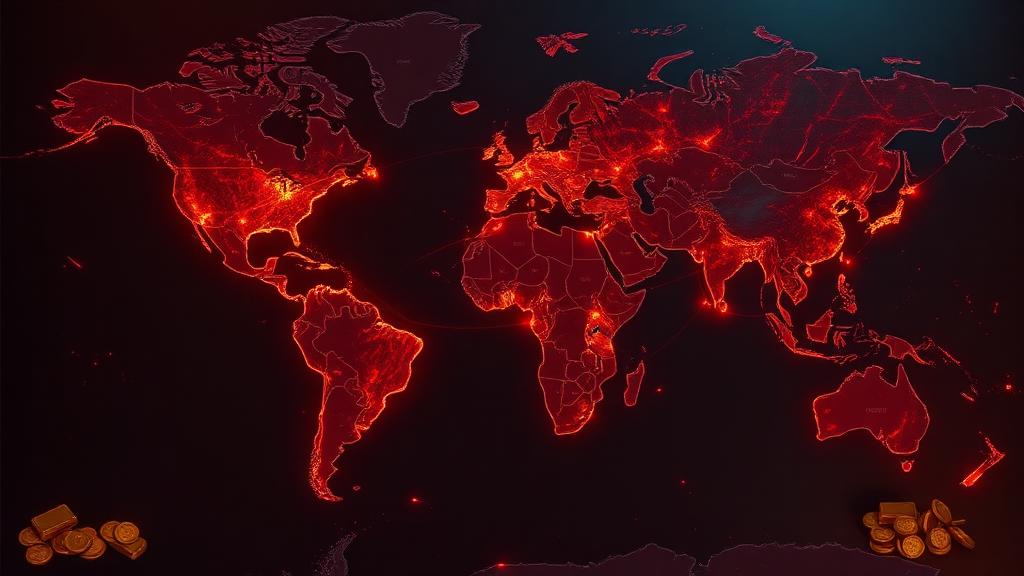
As of early 2026, the geopolitical environment is arguably more complex and unstable than at any point since the end of the Cold War. Multiple, simultaneous sources of tension are creating a background level of uncertainty that structurally supports precious metals demand:
- Russia-Ukraine: No resolution in sight, with ongoing implications for European energy security and global food supply
- Middle East: Multi-front regional instability affecting oil markets and global shipping routes
- U.S.-China tensions: Technology export controls, Taiwan contingency planning, and trade restrictions creating a potential economic cold war
- Global tariff escalation: Protectionist trade policies disrupting decades of globalization assumptions
- De-dollarization: BRICS expansion and alternative payment systems reducing dollar dominance
- Cyber warfare: State-sponsored attacks on critical infrastructure creating new categories of systemic risk
None of these tensions have clear resolution timelines. Many are likely to intensify. For gold and silver, this isn't a temporary tailwind — it's a structural shift in the global risk environment that supports sustained demand for tangible, non-political stores of value.
Conclusion
The relationship between geopolitical tension and gold prices isn't a coincidence, a correlation, or a trading pattern. It's a fundamental feature of how human beings respond to uncertainty — by seeking assets that don't depend on any government's stability, any institution's solvency, or any political relationship's durability.
Gold has served this function for millennia because it possesses qualities no paper asset can replicate: it's tangible, universally recognized, impossible to print, and independent of every political system on Earth. When geopolitical events shake confidence in the structures that underpin modern finance, gold doesn't just hold value — it gains value, as capital flows from assets that carry political risk to the one asset that doesn't.
Silver amplifies this dynamic with greater volatility and the additional tailwind of industrial demand that is itself sensitive to geopolitical disruption. Together, gold and silver provide a hedge not against any specific geopolitical event, but against geopolitical instability itself — a condition that shows every sign of being the defining feature of the decade ahead.
For investors, the implication is clear: a meaningful allocation to physical precious metals isn't a bet on any particular conflict or outcome. It's a recognition that the world is becoming more uncertain, not less — and that the assets best positioned for uncertainty are those that have weathered every form of it for 5,000 years.
This article is for educational purposes only and does not constitute investment, tax, or legal advice. Past performance is not indicative of future results. Consult a qualified financial advisor before making investment decisions.
Found this article helpful?
Take Our 1-Minute Gold IRA Match Quiz
Get a personalized recommendation based on your goals and investment style.
Frequently Asked Questions
Explore Related Topics
For Investors Who Don't Have Time to Chase Headlines
Industry news distilled into a scannable email.
Vincent Edwards
Vincent Edwards is the editor and lead analyst at Precious Metals Report, specializing in gold and silver market analysis, retirement investing, and macroeconomic trends.
Read more from this author